
Labradorite: what kind of stone is it? Properties and magical meaning
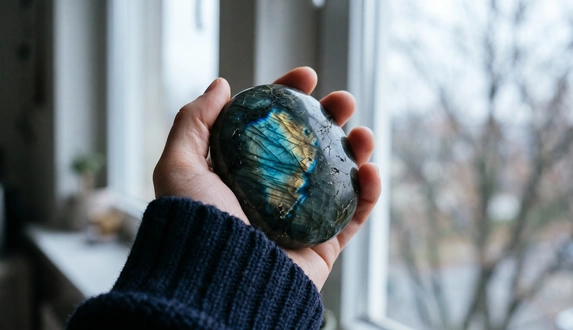
All it takes is a slight turn in your hand, and a grey, unassuming surface suddenly flashes with blue, green and gold. Labradorite is one of the most surprising natural stones – its rainbow reflections appear and vanish as it moves, as if it held the light of the aurora within. No wonder it has fascinated jewellers, collectors and lovers of stone symbolism for more than two hundred years.
The popularity of labradorite comes from a blend of two worlds: it is a mineral with a well-understood structure and, at the same time, a stone surrounded by legends. In this article, we explain what labradorite is, where its name comes from and what labradorescence is. We also describe what it looks like, what physical properties it has, where it is used and what meaning esoteric tradition attributes to it. Finally, we suggest how to choose labradorite and how to look after it. If you are interested in other minerals too, take a look at the category of stones and crystals.
Table of contents:
- Labradorite – what kind of stone is it?
- What does labradorite look like?
- Labradorite – physical properties
- Labradorite – properties and uses
- Labradorite – magical properties
- Labradorite – symbolic meaning
- How to choose labradorite?
- How to care for labradorite?
Labradorite – what kind of stone is it?
Labradorite – what kind of stone is it? In short, it is a mineral from the plagioclase feldspar group, one of the most widespread groups of minerals in the Earth’s crust. It belongs to a series that mineralogists describe as running from albite (a sodium-rich feldspar) to anorthite (a calcium-rich feldspar). Labradorite sits roughly in the middle of it – it contains more calcium than sodium. Polish mineralogists also use the name “labrador”, and geologists sometimes use “labradorite” for a rock made up mainly of this mineral. In the trade and among ornamental stones, however, “labradorite” is the established name.
What sets labradorite as an ornamental gemstone apart from many other feldspars is the play of coloured reflections that appear on its surface at a certain angle. Without this effect it would simply be a grey, rather ordinary mineral. It is the shimmering colours that brought it into jewellers’ workshops and collections. To see what it looks like in its natural form, take a look at this raw piece of labradorite.
The origin of labradorite
The stone takes its name from the Labrador Peninsula in eastern Canada. Around 1770, Moravian missionaries working among the Indigenous inhabitants near Nain noticed the shimmering stones and sent specimens to Europe. Ten years later, in 1780, the mineral was formally described and named after the place where it was found. Specimens quickly found their way into European collections.
Labradorite also has its own legend. According to a tale attributed to the Inuit, the aurora was once trapped in the rocks of the Labrador coast. A warrior struck a stone with his spear and freed part of its light, which rose into the sky. The rest of the radiance remained in the rock – and it is this that we see today in the reflections of labradorite. The legend captures well what many people feel on first meeting this stone. We also describe labradorite and other stones with exceptional energy in the round-up Top 10 energy stones and their properties.
The most important feature of labradorite – labradorescence
Labradorescence is the optical phenomenon to which the stone owes its fame. It consists of the appearance of intense, metallic-looking reflections – blue, green, gold, orange and sometimes purple. They are not dyes or impurities. The colours arise through the interference of light, that is, the overlapping of light waves reflected from extremely thin layers inside the stone. A similar phenomenon can be seen on a soap bubble or an oil slick on water.
These thin layers form when labradorite cools very slowly deep within the Earth – two kinds of feldspar then separate into alternating, microscopically thin plates. The thickness of these plates determines the colour of the reflection, and because very slow cooling is needed, not every labradorite shimmers. The phenomenon was studied and described in the 1920s by the Danish mineralogist Ove Balthasar Bøggild. The intensity of labradorescence depends on the structure of the particular stone, its orientation and the angle at which light falls on it. The same specimen can look plain grey from one side and, after a slight turn, flash with the full range of colours.
💡 Did you know? A particularly striking variety of labradorite, shimmering with almost the whole spectrum of colours, is called spectrolite. Its deposit was discovered in 1940 near Ylämaa in Finland, during the construction of defensive fortifications. The name spectrolite refers above all to Finnish stones, although in the trade it is sometimes used more widely.
Where is labradorite found?
Labradorite is a component of many igneous rocks, but specimens with beautiful labradorescence are found only in certain places. Besides Canada, which gave the stone its name, important sources include Finland (spectrolite), Madagascar, Russia and Ukraine. Deposits are also known in Australia, the United States, Mexico and India. Norway is often mentioned too, although the popular Norwegian stone with a blue sheen is usually larvikite – a different rock, which we write about in the section on colours. Many of the stones available on the market today come from Madagascar.
Labradorite in our shop comes as raw pieces from Madagascar weighing about 150 g – each one may differ slightly in colour and reflections.
View labradoriteOrigin can influence the look of the stone: its base colour, transparency and the intensity of its reflections. Stones from Madagascar and Russia usually have a grey to black base colour, while in India lighter, transparent specimens are found. In the category of stones and crystals you will also find minerals from other corners of the world.
What does labradorite look like?
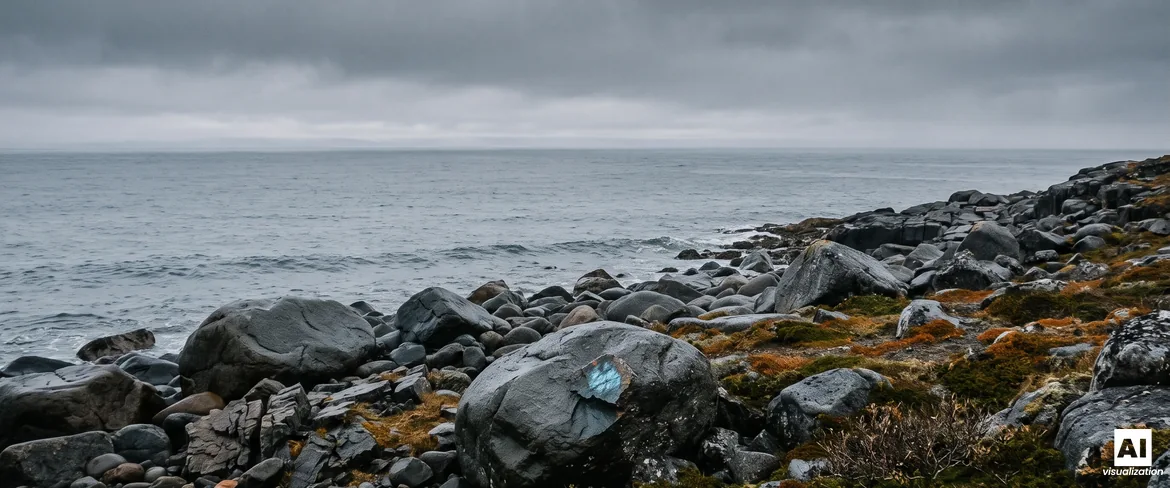
What does labradorite look like? Its base colour is usually subdued: grey, graphite, greyish blue or almost black. Lighter, nearly transparent specimens are found less often. Against this calm background appear glossy patches and streaks of colour that behave like moving light – they spread across the surface as the stone is moved and fade when the viewing angle changes. Every specimen differs in pattern, colours and intensity of the effect, which is why no two labradorites are identical.
Labradorite colour – which shades can you find?
The most common labradorite colour is blue or green – these shades are the ones most associated with the stone. Turquoise and gold tones also appear often, and in some specimens orange, red and purple. Stones that shimmer in several colours at once are called multicoloured. Sellers usually regard violet, pink and intense red as rarer, but that is a market judgement, not a strict mineralogical rule. Turn the stone by just a few degrees and blue can shift to green or vanish. Labradorite is therefore best viewed in motion and in different light – in daylight and under a lamp it can look quite different.
📌 Black labradorite and rainbow moonstone – what hides behind these names?
- ✔️ Black labradorite is most often the trade name for larvikite, a rock from the Larvik area of Norway in which feldspar crystals give a silvery blue sheen. It is a beautiful stone, but not the same as labradorite.
- ✔️ Dark labradorite with a graphite, almost black base colour, on the other hand, is genuine labradorite, and its reflections stand out well against the dark background.
- ✔️ Rainbow moonstone, despite its name, is a pale, almost transparent variety of labradorite with a blue sheen, and not a moonstone.
Raw labradorite and polished stone
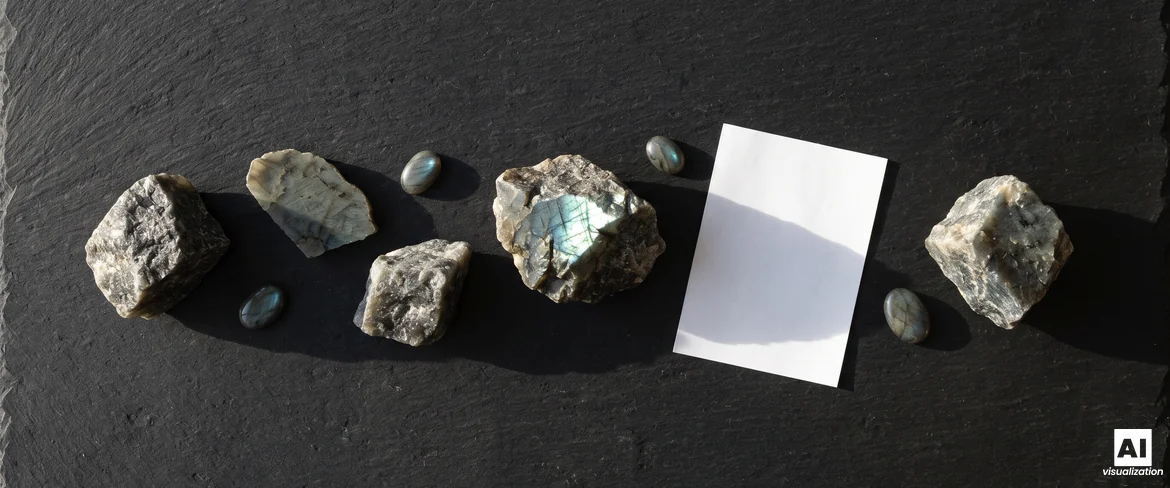
Raw labradorite has an irregular shape, often a matt, rough surface and clearly visible cleavage planes. Reflections can be seen in it, but usually only in certain places – where the surface happens to have exposed the thin layers at the right angle. Such a stone has something primal about it, which is why it is prized as a decoration and as a collector’s piece that shows the mineral’s natural structure.
Cutting and polishing bring out the labradorescence better. An experienced lapidary positions the stone so that its surface is parallel to the internal layers – the reflections then cover a larger part of the stone and are more intense. As a result, cabochons and polished stones often shimmer more strongly than raw pieces. The choice between them depends on whether natural character or striking brilliance matters more.
Labradorite – physical properties
Labradorite is a mineral of moderate hardness and rather distinctive structure. It is worth knowing its basic parameters, because they hint at how to wear and store it. We have gathered the most important data in a table. You will find raw stones, in which the natural structure of various minerals is clearly visible, in the category of raw stones.
Labradorite – key physical characteristics
| PARAMETER | VALUE / DESCRIPTION |
|---|---|
| Mineral group | Plagioclase feldspars (calcium sodium aluminosilicate) |
| Hardness (Mohs scale) | 6-6.5 |
| Density | Approx. 2.7 g/cm³ |
| Lustre | Vitreous, pearly on cleavage planes |
| Transparency | From transparent to translucent (ornamental stones are usually opaque) |
| Cleavage | Perfect in one direction, weaker in the other |
| Crystal system | Triclinic |
| Base colour | Grey, graphite, greyish blue, sometimes pale or colourless |
| Optical effect | Labradorescence – directional, rainbow reflections |
A hardness of 6-6.5 on the Mohs scale means that labradorite is slightly softer than quartz, and therefore also than rock crystal or amethyst. Everyday dust, which contains tiny particles of quartz, can over time dull its polished surface. More important than hardness, however, is cleavage: labradorite has planes along which it splits more easily. A hard knock or a fall onto a hard floor can cause a crack or a chip.
Natural features are often visible in the stone: fine cracks along the cleavage planes, dark inclusions of other minerals and delicate banding. They are not flaws, but traces of the processes in which the stone formed.
Labradorite – properties and uses
Thanks to its remarkable play of colours, labradorite is used above all in jewellery. That is not its only use, however: it is also prized in collecting, interior decoration and art projects.
Labradorite in jewellery
Bracelets, necklaces, rings, earrings and pendants are made from labradorite. A particular favourite is the labradorite bracelet made of round beads – on each one the reflections fall differently, so the piece shimmers with every movement of the hand. In pendants and rings, cabochons are most often used, that is, stones cut into a smooth, domed shape that shows off labradorescence best.
Because of its cleavage, labradorite works best in jewellery less exposed to knocks: in pendants, earrings and brooches. Cool blue reflections look beautiful in a silver or steel setting, while warm golden flashes go well with gold. You will find inspiration and other stones in jewellery in the category of jewellery.
We recommend


Labradorite as a decorative and collector’s stone
Beyond jewellery, labradorite comes as raw pieces, polished specimens, slabs, spheres, figurines and cabochons. A large, polished stone can become the centrepiece of a shelf or desk – in the changing light of day it looks a little different every time. Raw pieces are a popular choice for people who like the natural, unworked look of minerals and want to watch reflections appear on the natural cleavage planes.
For collectors, specimens with intense, multicoloured labradorescence, rarer reflection colours and an interesting pattern are especially attractive. Stones from particular deposits, such as Finnish spectrolite, are also prized. Stones displayed on a shelf are worth dusting and rinsing from time to time and, if you use them in meditation, cleansing symbolically too – the guide How to purify stones and crystals? will help with that.
Labradorite – magical properties
The magical properties of labradorite that esotericism speaks of are beliefs and symbolic meanings, not features confirmed by science or medicine – and they should be treated as such. In esoteric tradition, labradorite is regarded as a stone of mystery and magic that links the visible world with the invisible.
In esoteric tradition, the labradorite stone is most often associated with the following:
- ✨ protection – labradorite is sometimes described as a protective, shielding stone, symbolically sheltering the wearer from other people’s emotions and negative influences,
- ✨ support for intuition – it is associated with sharpening the inner voice and trusting one’s own hunches,
- ✨ concentration – it is sometimes chosen as a companion for study, creative work and meditation,
- ✨ personal development – it symbolises discovering hidden talents and getting to know oneself,
- ✨ work with the chakras – it is most often linked with the Third Eye Chakra, as well as the Throat Chakra and the Crown Chakra.
Many people wear labradorite as an amulet or keep it in a pocket, a bag or on a desk as a reminder of their own intention. It is sometimes part of rituals too: meditation, work with affirmations or cleansing a room with white sage smoke. During such a practice you can hold the stone in your hand and focus on what you want to strengthen within yourself.
It is worth remembering that the symbolic protection attributed to labradorite does not replace real action or professional help. The stone can be a personal reminder, a sign of intention or a beautiful talisman, but in difficult situations the most important thing is the support of loved ones and specialists.
Labradorite – symbolic meaning
The symbolic meaning of labradorite stems above all from its appearance. A stone that is grey and modest in everyday light, yet reveals a feast of colours in the right light, has long been interpreted as a symbol of transformation. It is a reminder that inner strength and potential are often hidden and reveal themselves only at the right moment – when perspective shifts or a new light appears.
Contemporary symbolism also links labradorite with opening up to new possibilities. The aurora from the Inuit legend, enclosed in stone, becomes an image of something extraordinary that can be discovered in ordinary everyday life.
What does labradorite symbolise?
The most important associations with labradorite in esoteric tradition are:
- 🔮 intuition – the changing reflections symbolise what is perceived not with the eyes but with inner awareness,
- 🌌 mystery – a stone that hides light beneath a grey surface is an image of what cannot be seen at first glance,
- 🦋 transformation – a stone associated with inner growth and readiness for change,
- 🎨 creativity – the play of colours symbolises imagination and new ideas,
- ⚖️ inner balance – the union of the energies of the Sun and the Moon is said to symbolise the harmony of opposites.
For these reasons, labradorite is sometimes chosen as a personal talisman during important life changes: moving home, starting a new job or beginning a course of study. In round-ups of zodiac stones it is often linked with Scorpio and Cancer, and in some also with Sagittarius, Leo or Aquarius – there is no single, established tradition here. You can read more about the stones of these signs in the posts Which stone for Aquarius to choose? Zodiac and protective stones and Which stone to choose for Scorpio? Zodiac, protective and lucky talismans.
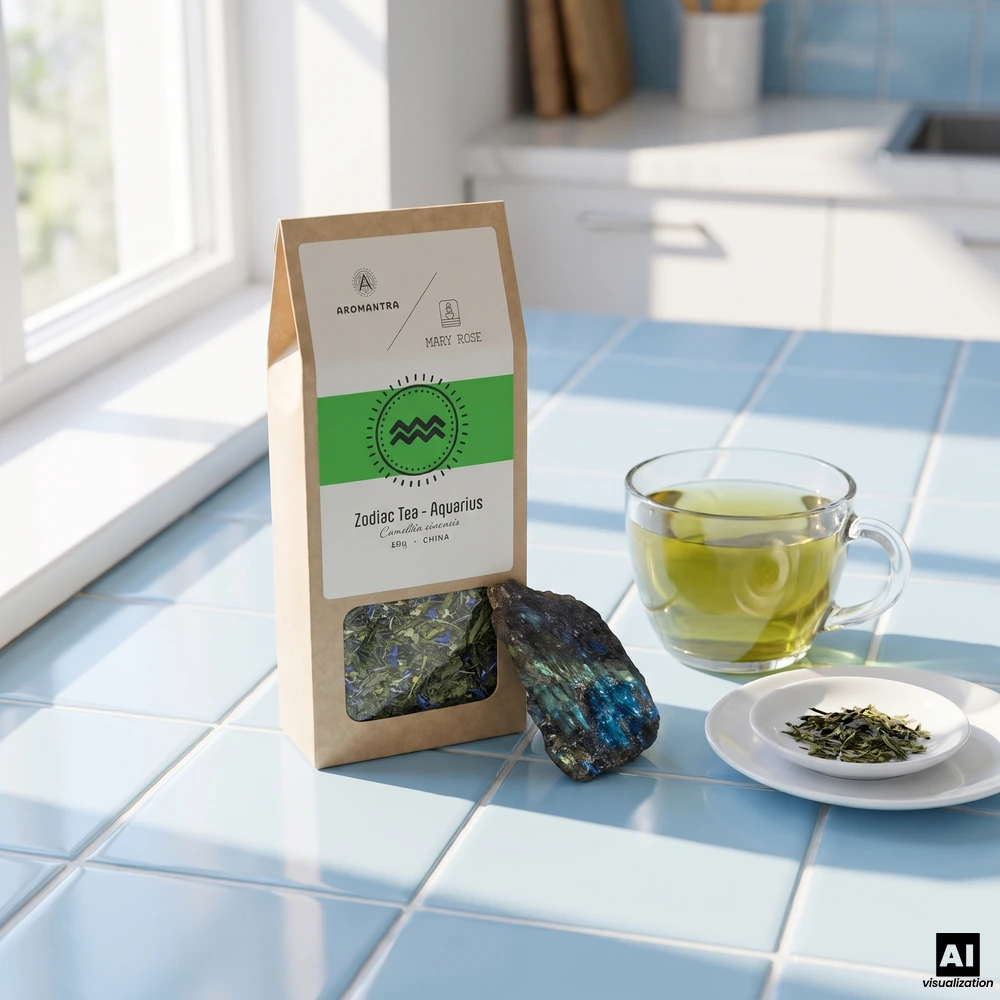
♒ Zodiac set for Aquarius with labradorite
A ready-made set for people born under Aquarius, or to give to them as a gift. It combines labradorite, which is sometimes associated with this sign, with zodiac tea. The set contains:
- ✔️ labradorite – 1 pc,
- ✔️ Aquarius zodiac green tea – 50 g.
How to choose labradorite?
Choosing labradorite is largely a matter of personal response – many people say that the stone “chooses” them when it flashes their favourite colour at just the right moment. A few practical tips will, however, help you find a specimen you will enjoy for years.
- ✔️ View the stone in motion. Turn it in your hand, or ask for photos and a video from several sides – labradorescence is directional and may not show in a single photo.
- ✔️ Pay attention to the intensity of the reflections. The more of the stone the colours cover, and the more vivid they are, the more striking the specimen.
- ✔️ Check the quality of the polish. On cut stones the surface should be smooth and shiny, without matt patches or scratches.
- ✔️ Do not be put off by natural cracks and inclusions. Fine lines and dark needles are typical features of labradorite, although deep cracks can weaken the stone.
- ✔️ Match the shape and size to the intended use. A large piece works as a decoration, a cabochon suits a pendant and small beads suit a bracelet.
- ✔️ Follow your own preferences. Some people choose cool blue, others warm gold or a multicoloured play of light – there is no wrong choice.
If you want to work with several stones at once, labradorite is nicely complemented by minerals associated with intuition and calm, such as amethyst or sodalite, as well as versatile rock crystal. In esoteric tradition they are combined to symbolically strengthen an intention.
We recommend


How to care for labradorite?
Labradorite does not require complicated care, but because of its moderate hardness and cleavage it is worth handling gently. The safest way to clean it is with a soft, damp cloth or lukewarm water with a little mild soap, followed by thorough drying.
- ✔️ Avoid strong cleaning products. Products containing bleach or acids can damage the surface of the stone.
- ✔️ Do not use ultrasonic cleaners or steam. Vibrations and high temperatures can deepen natural cracks.
- ✔️ Protect the stone from high temperatures and sudden changes in temperature. Do not leave it on a radiator or in a heated car.
- ✔️ Avoid hard knocks. Take off labradorite jewellery before sport, housework and gardening.
- ✔️ Store it separately. Ideally in a soft pouch or a compartment of a jewellery box, away from harder jewellery that could scratch it.
Many people also pay attention to the symbolic, energetic cleansing of their stones – with smoke, sound or moonlight. We have described methods matched to different minerals in the guide How to purify stones and crystals? A guide for everyone.
Labradorite is a stone full of contrasts: modest at rest and dazzling in motion. Its reflections are the physics of light, and its symbolism is a story of transformation and hidden potential. Whether it appeals to you as an ornament, a collector’s piece or a personal talisman, it is worth looking at it up close and finding a specimen that will flash just for you.
May labradorite remind you that the most beautiful colours often lie just beneath the surface!
FAQ – frequently asked questions about labradorite
1. Labradorite – what kind of stone is it?
Labradorite is a mineral from the plagioclase feldspar group, a calcium sodium aluminosilicate. It is famous for labradorescence, that is, rainbow reflections visible at a certain angle. It owes its name to the Labrador Peninsula in Canada, where it drew attention around 1770.
2. What does labradorite look like?
Labradorite usually has a grey, graphite or almost black base colour, on which glossy reflections appear in blue, green, gold and other colours. The colours shift and vanish as the stone moves, and every specimen has a different pattern and intensity of effect.
3. What colours can labradorite come in?
Blue and green reflections are the most common, often also turquoise and gold. Orange, red and purple shades appear less often. Stones that shimmer in many colours are called multicoloured, and the Finnish variety with reflections in almost the whole spectrum of colours is spectrolite.
4. What is labradorescence?
Labradorescence is an optical phenomenon in which coloured, metallic-looking reflections appear on the surface of the stone. They arise from the interference of light on microscopically thin layers inside the mineral. The effect is directional, so it can be seen only at a certain angle.
5. Can labradorite be black?
Labradorite can have a very dark, graphite or almost black base colour, against which the reflections stand out well. In the trade, however, the name “black labradorite” most often refers to larvikite, a different rock from Norway with a silvery blue sheen.
6. What physical properties does labradorite have?
Labradorite has a hardness of 6-6.5 on the Mohs scale, a density of approx. 2.7 g/cm³, a vitreous lustre and crystallises in the triclinic system. It has pronounced cleavage, so it can crack under a hard knock and needs gentle handling.
7. What does labradorite symbolise?
The meaning of labradorite in esoteric tradition is symbolic: it is associated with intuition, protection, transformation, creativity and inner balance. It is sometimes chosen as a talisman for times of important change and new beginnings. These are symbolic meanings, not properties confirmed by science.
8. How to clean labradorite?
It is best wiped with a soft, damp cloth or washed in lukewarm water with mild soap and dried thoroughly. Do not use strong cleaning products, ultrasonic cleaners or steam. Labradorite is best stored separately, away from harder jewellery.
9. Which zodiac sign is labradorite associated with?
In round-ups of zodiac stones, Scorpio and Cancer are most often mentioned, and less often Sagittarius, Leo and Aquarius. There is no single, established tradition, however, and labradorite is not a birthstone, so anyone who feels close to its symbolism can choose it.
10. Is rainbow moonstone labradorite?
Yes – the stone sold as rainbow moonstone is a pale, almost transparent variety of labradorite with a blue sheen. Despite the name, it is not a moonstone, although both minerals belong to the feldspar group.
Recommended

Labradorite (raw stone) 1 pc.

Set for Aquarius: zodiac tea + magic gemstone

Set of 7 Chakra Stones – in a pouch
