
Jadeite – properties, colours and meaning of the stone
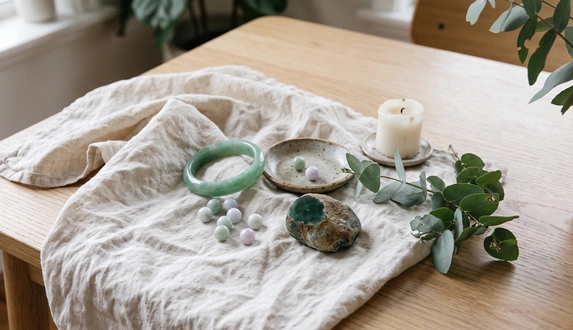
Smooth, cool to the touch and rich in deep shades of green, jadeite has delighted craftspeople, collectors and lovers of stone symbolism for thousands of years. In China it has ranked among the most precious jewellery materials since the 18th century, while in Mesoamerica it was treasured by the Olmecs and the Maya. Today it is one of the most recognisable ornamental stones in the world, combining exceptional toughness with a subtle, refined look.
Although jadeite is associated above all with green, it actually occurs in many colours – from milky white and lavender to warm red and honey yellow. In this article, we explain what this mineral is, what it looks like, which physical properties have been confirmed and what meaning tradition attributes to it. We also share tips on how to recognise genuine jadeite, how to wear it in jewellery and how to look after it. If you are interested in other minerals too, take a look at the category of stones and crystals.
Table of contents:
- Jadeite – what kind of stone is it?
- What does jadeite look like?
- Jadeite – physical properties of the stone
- Jadeite – properties and meaning of the stone
- Jadeite as a massage stone
- Jadeite colours – varieties of the stone and their meaning
- How to recognise genuine jadeite?
- Jadeite in jewellery
- How to care for jadeite?
Jadeite – what kind of stone is it?
When the question of what is jade comes up, the shortest answer is this: jadeite is a mineral that, together with nephrite, forms the group of stones known as jade. For centuries the two were treated as one and the same stone, because they look similar and are equally well suited to carving. It was only in 1863 that the French mineralogist Alexis Damour showed that they are two entirely separate minerals. Jadeite is therefore not a general name for any “green stone”, but a specific mineral with a defined composition and structure.
The history of the name itself is interesting too. The word jade comes from the Spanish phrase piedra de ijada, meaning “stone of the flank”. The Spaniards, who first encountered this stone in Central America, adopted the local belief that it eased complaints of the loins. Today this is merely an etymological curiosity, not a property of the stone.
Jadeite as a mineral
From a mineralogical point of view, jadeite belongs to the pyroxene group. It is a sodium aluminium silicate with the formula NaAlSi₂O₆. It is noticeably heavier than many ornamental stones of the same size, and we describe its detailed parameters in the chapter on physical properties. Its greatest asset, however, is its structure: jadeite is made up of tiny, tightly interlocked crystals. This makes it very resistant to cracking and chipping, which for centuries has allowed craftspeople to carve delicate, intricate forms from it.
The value of a jadeite stone depends above all on its colour, translucency and the uniformity of its structure. The most highly prized stones have an intense, even green and great translucency, but the price is also affected by texture, the care taken in working the stone and whether it has been treated.
📌 Jadeite and nephrite – the most important differences
- ✔️ Mineral: jadeite is a pyroxene, nephrite an amphibole (a variety of tremolite or actinolite).
- ✔️ Hardness: jadeite 6.5-7, nephrite 6-6.5 on the Mohs scale (nephrite, however, is slightly more resistant to cracking).
- ✔️ Density: jadeite approx. 3.3 g/cm³, nephrite approx. 2.95 g/cm³.
- ✔️ Appearance: jadeite occurs in a richer range of colours and has a glassy lustre when polished, while nephrite is usually more greasy or waxy.
Where is jadeite found?
Jadeite forms under specific conditions – at high pressure and relatively low temperature, in zones where tectonic plates meet. This is why its deposits are rare. The most important source is Myanmar (formerly Burma), more precisely the Kachin region around Hpakant – the vast majority of gem-quality jadeite comes from here. The second famous deposit is the Motagua river valley in Guatemala, from which the Olmecs and the Maya obtained their jadeite. After the conquest this source was forgotten for a long time and was only rediscovered in 1974.
Jadeite is also mined in Japan, around the city of Itoigawa, where in 2016 jadeite was named the country’s national stone. Smaller deposits can be found in Russia (in the Polar Urals), Kazakhstan and California, among other places. The place of origin and the quality of the raw material affect the appearance of the stone, and therefore its price.
What does jadeite look like?
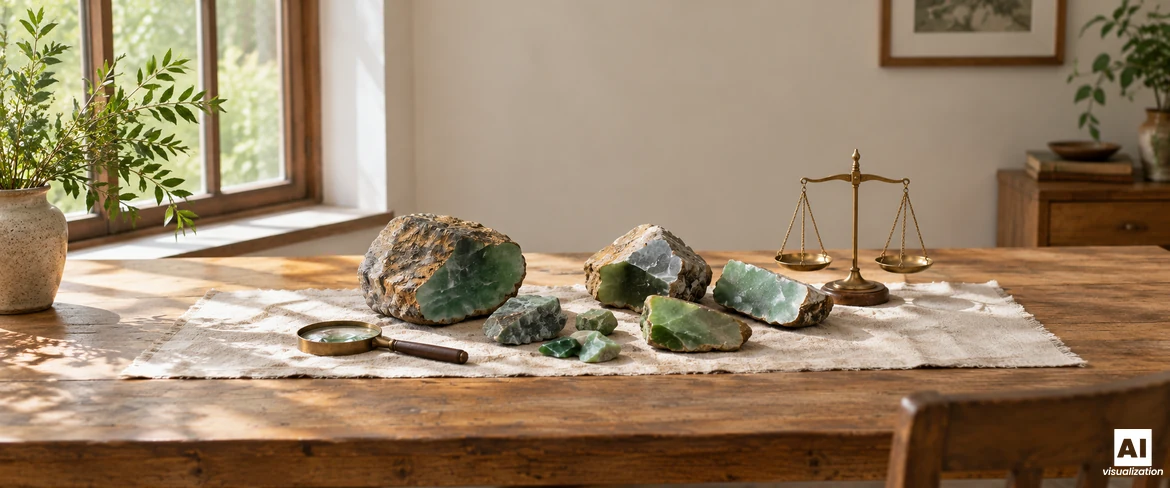
If you are wondering what jadeite looks like, it is worth abandoning the idea of a single, ideal model straight away. This mineral can be uniformly green or streaked, milky and opaque or translucent like glass. Every specimen differs in colour, translucency and pattern, and natural variations are not a flaw in the stone – they are simply a trace of the processes in which it formed.
The appearance and structure of jadeite
Raw jadeite is often unassuming. On the outside it is covered by a matt, weathered layer called the weathering rind, which can be an entirely different colour from the interior. The true beauty of the stone is revealed only after it has been cut and polished: the surface becomes smooth and the lustre glassy, sometimes slightly greasy. Polished jadeite has a characteristic, “soft” depth, as if the light were scattering just beneath the surface.
In the structure of the stone you can often see natural streaks, faint colour variations and areas of differing colour saturation. Green may form patches, veins or little clouds against a paler background. Such variation gives each stone an individual character and makes every jadeite stone one of a kind – even two beads from the same block will look slightly different.
Translucency, lustre and natural inclusions
Jadeite can be opaque, translucent or – in the rarest varieties – almost transparent. The more light it lets through, the more “alive” it appears. Translucency depends on the size and arrangement of the tiny crystals: the finer they are and the more tightly they are joined, the more translucent the stone.
Inside jadeite you can often spot inclusions, that is, tiny grains of other minerals, small dark dots, white “clouds” or delicate lines. They are a natural part of the stone and evidence of its origin, not necessarily a sign of low quality. What matters more for value is whether the inclusions are visible to the naked eye and whether they weaken the structure of the stone, rather than the mere fact of their presence.
Is all jadeite green?
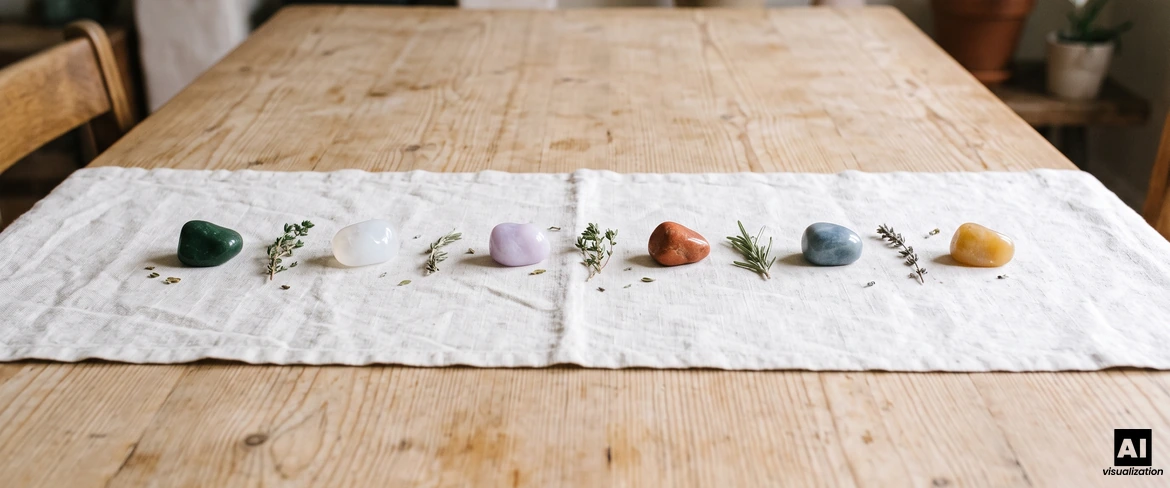
No. Although green jadeite is the most recognisable, the mineral also occurs in white, purple (lavender), red, blue, yellow and even black. Pure jadeite is white, and its colour comes from traces of other elements. We discuss the individual colour varieties in detail later in the article.
Jadeite – physical properties of the stone
When we talk about the properties of jadeite, we should begin with those that can actually be measured and confirmed. They are the reason this stone has been used for thousands of years to make tools, sculptures, ornaments and everyday objects. Jadeite is hard, heavy and – most importantly – exceptionally tough. Its interlocked crystals act like a tightly woven fabric: instead of cracking under impact, they disperse the stress.
Jadeite – key physical characteristics
| PARAMETER | VALUE / DESCRIPTION |
|---|---|
| Mineral group | Pyroxenes (sodium aluminium silicate, NaAlSi₂O₆) |
| Hardness (Mohs scale) | 6.5-7 |
| Density | Approx. 3.3 g/cm³ |
| Lustre | Glassy, sometimes slightly greasy |
| Translucency | From opaque to translucent, rarely almost transparent |
| Toughness | Very high resistance to cracking and chipping thanks to interlocked crystals |
In practice this means that jadeite copes well with everyday use – it will not be scratched by glass or by softer steel, and thin pieces rarely break. It is not indestructible, however. Harder minerals, such as topaz or corundum, can scratch it, and a hard knock against a stone floor can be dangerous even for such a tough stone.
The physical properties of jadeite are worth distinguishing clearly from those attributed to it in tradition and esoteric lore. Hardness, density and resistance to cracking are facts that any gemmological laboratory can confirm. Calm, harmony and prosperity, on the other hand, are symbolic meanings rooted in culture and belief. If you are interested in the symbolism of other popular stones, take a look at the post Top 10 energy stones and their properties.
Jadeite – properties and meaning of the stone
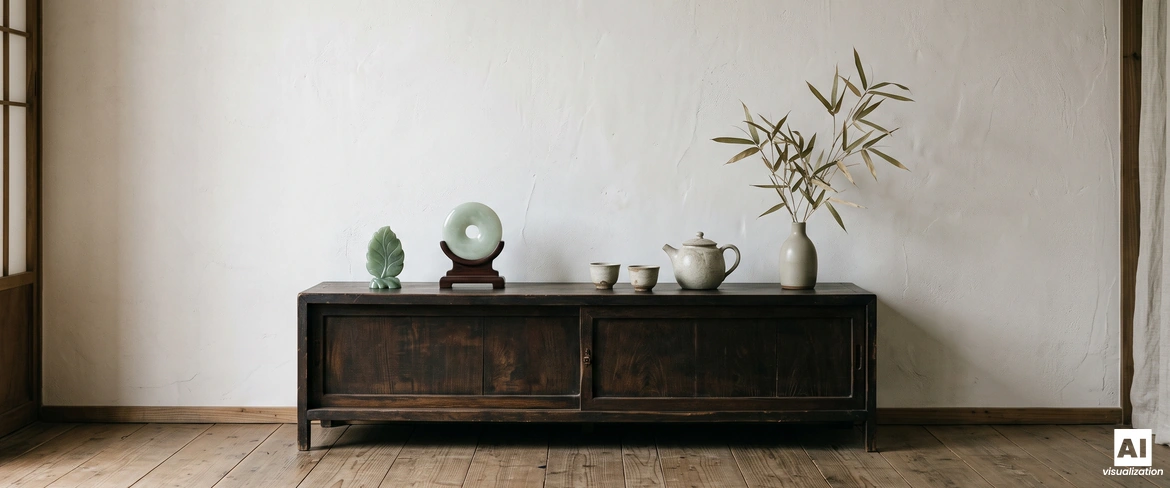
Few stones have a cultural history as rich as jadeite. In China the word yù, usually translated as “jade”, meant mainly nephrite for thousands of years. Jadeite from Burma, known in Chinese as feicui, became hugely popular in the 18th century under the Qianlong Emperor, and the fashion for it reached its peak in the time of Empress Dowager Cixi, famed for her love of green ornaments. Since then jadeite has been a symbol of luxury, nobility and good taste in China.
Earlier, on the other side of the ocean, jadeite was one of the most precious materials for the Olmecs and the Maya. It was associated with water, maize and life, and jadeite beads were placed in the mouths of the dead. The same green that symbolised prosperity in Asia was a sign of renewing nature in Central America.
💡 Did you know? In 2014 the Hutton-Mdivani jadeite necklace, made by the jewellery house Cartier, was sold at auction in Hong Kong for approx. 27.4 million US dollars. It remains the record price for jewellery featuring jadeite. It is also worth knowing that the famous Beijing 2008 Olympic medals, decorated with a green stone, contained nephrite, not jadeite.
Jade stone properties attributed by tradition
The magical and spiritual jade properties traditionally attributed to jadeite come from belief, not scientific research – and that is how they should be treated. In Chinese culture, jade was compared to the virtues of a noble person: its lustre was said to stand for kindness and its hardness for wisdom. In esoteric tradition, jadeite is most often associated with harmony, calm, protection, wisdom, prosperity and abundance. This is why amulets, pendants and bracelets have been made from it for centuries, meant to serve as a reminder of these values.
🔮 The symbolism of jadeite in esoteric tradition
- ✔️ Harmony and calm: a stone associated with balance and gentleness.
- ✔️ Protection: in contemporary esotericism, worn as a protective talisman.
- ✔️ Wisdom: a symbol of clarity of mind and prudence.
- ✔️ Prosperity and abundance: in Asia, a traditional gift for good luck.
- ✔️ Heart chakra: in contemporary esotericism, green jadeite is most often linked with the heart chakra.
- ✔️ Zodiac signs: in esoteric lists, most often assigned to Taurus and Libra.
The link between jadeite and the heart chakra stems from its green colour, traditionally connected with this energy centre. You can read more about such associations in the guide Gemstones vs Chakras. It is worth remembering that the symbolic meaning of a stone can be a lovely reminder of your own intentions, but it does not replace treatment or professional help when it is needed.
Jadeite as a massage stone
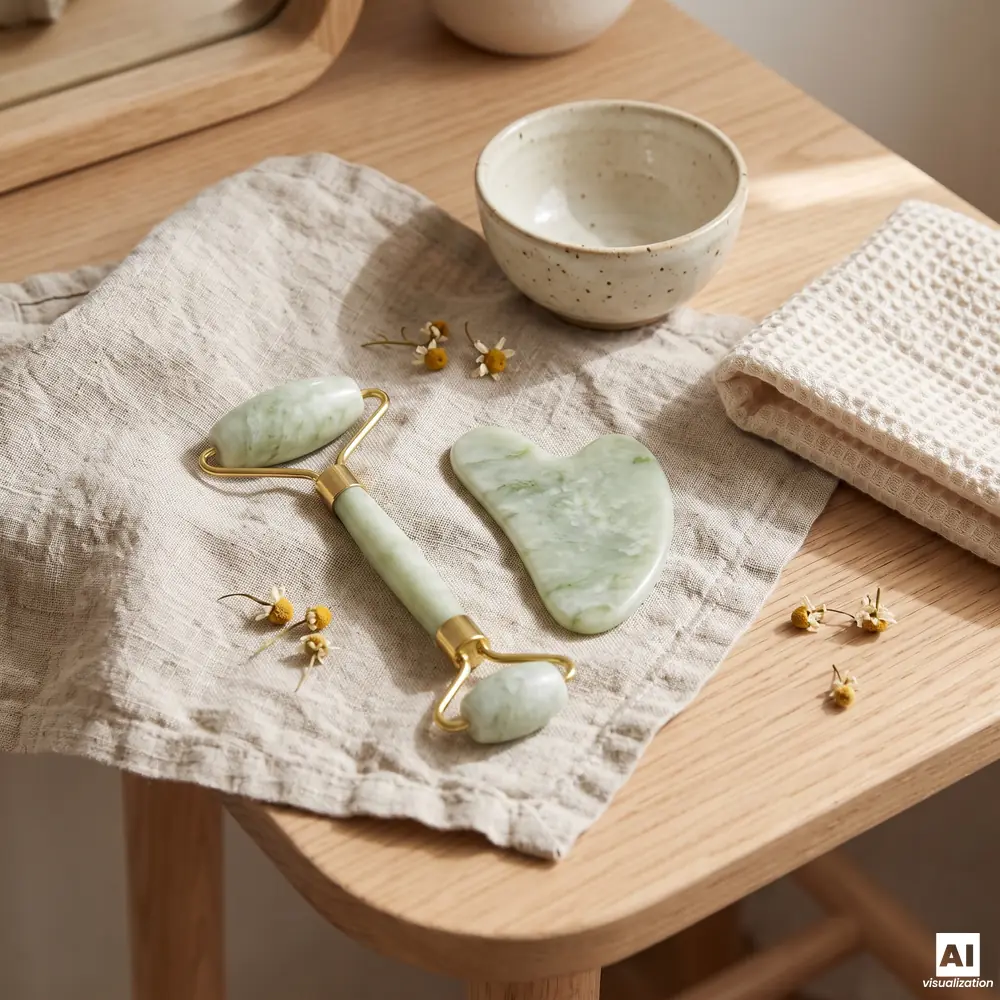
Its smooth, cool surface means that stones called jadeite have long been used to make accessories for facial and body massage. The most popular are gua sha plates, double-roller massagers and smoothed massage stones. Gua sha is a traditional Chinese technique in which the skin is stroked with a flat tool made of stone, horn or porcelain. Today it is most often treated as a pleasant skincare ritual and a moment of relaxation during the day.
The stone works well in this role for several reasons. It feels cool on first contact with the skin, it is easy to keep clean, and a smoothly polished surface glides pleasantly over skin coated with oil or serum. With proper care, such an accessory will last a long time.
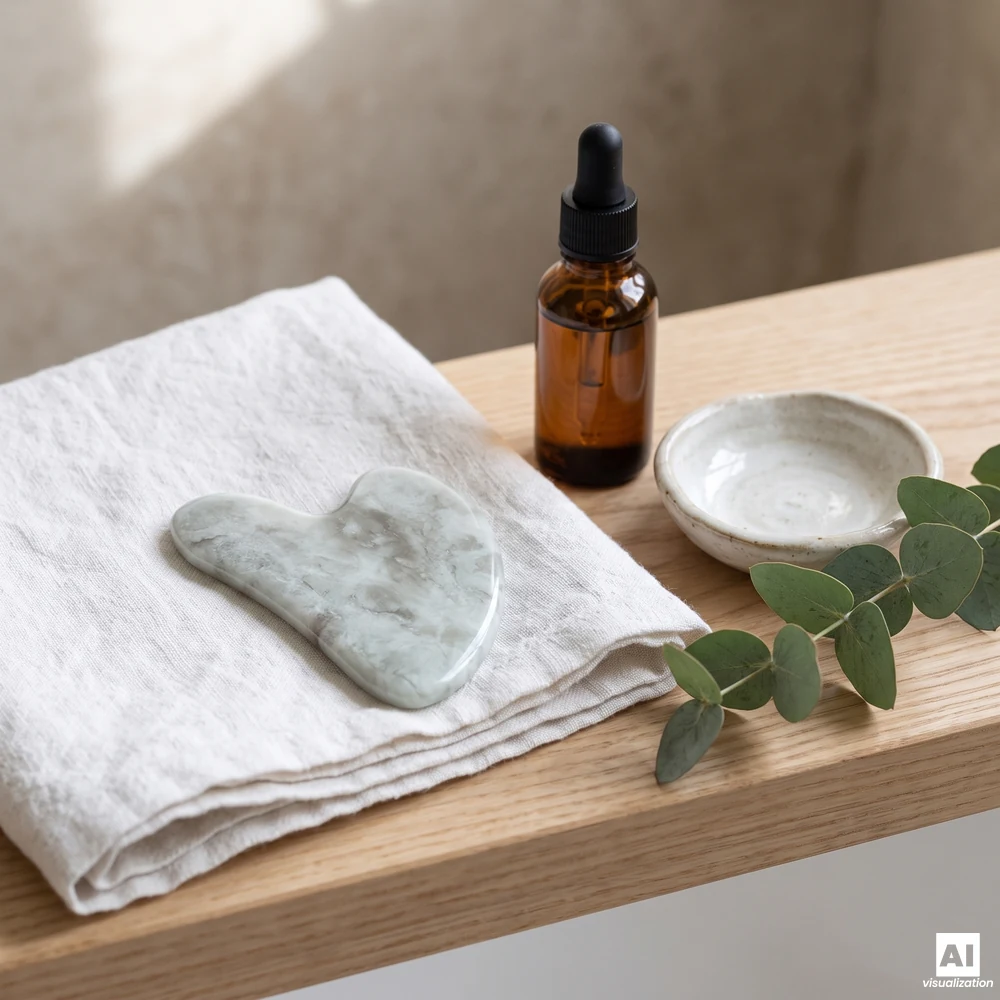
💚 Gua Sha Massage Stone – Jadeite
A flat, smoothly polished plate measuring approx. 8 × 6 cm and weighing approx. 40 g. It is suited to gentle massage of the face, as well as the arms, back or legs.
- ✔️ before use, it is worth cleansing the skin and applying a serum or oil,
- ✔️ the plate is guided with long upward strokes and from the centre outwards,
- ✔️ the massage is done without firm pressure,
- ✔️ each piece may differ slightly in colour and translucency.
A gua sha massage can be added to an evening skincare routine, setting aside a few unhurried minutes for it. For many people it is not only part of caring for the skin but also a moment of calm after a busy day – especially when accompanied by a favourite oil and dimmed lighting.
✨ Face Massager – Jadeite
The double-roller massager is a handy complement to the gua sha plate, especially useful in a morning face and neck routine.
- ✔️ two rollers of different sizes – the larger one for the face and neck, the smaller one for the area around the nose and under the eyes,
- ✔️ length approx. 14 cm, weight approx. 70 g,
- ✔️ it is guided gently, from the centre of the face outwards.
See the face massager in the shop
Both massage accessories can be found in the cosmetic accessories category.
Jadeite colours – varieties of the stone and their meaning
Colour is one of the most important features of jadeite – it determines both its character and its value. The colour depends on trace elements: chromium gives an intense green, iron gives olive and dark greens, and iron oxides, which seep into the stone near the surface, are responsible for red, brown and yellow shades. The meanings attributed to individual colours, on the other hand, are cultural and esoteric in nature.
Jadeite colours – a quick overview
| COLOUR | WHERE IT COMES FROM | SYMBOLISM |
|---|---|---|
| Green | Chromium, iron | Prosperity, harmony, growth |
| White | Pure jadeite with no trace elements | Purity, calm |
| Purple | Mainly manganese | Intuition, spirituality, stillness |
| Red | Iron oxides | Energy, courage, activity |
| Blue | Cause not fully explained (typical of Guatemala) | Calm, balance, communication |
| Yellow | Iron oxides | Joy, optimism, abundance |
Green jadeite
This is the best-known and most highly valued variety of the stone. Shades of green are remarkably varied – from delicate apple green, through mint and olive, to a deep, saturated hue. The most valuable is so-called imperial jadeite: an almost transparent stone with a vivid, emerald-green colour that it owes to traces of chromium. As for green jade properties, tradition attributes to this variety above all prosperity, harmony and growth, which is why in Asia it is often given as a good-luck gift.
White jadeite
White jadeite can resemble milk, ivory or pale grey. It is the purest form of the mineral, almost free of colouring trace elements, often with subtle green streaks or flecks. Its delicate, understated look makes it a perfect match for minimalist jewellery and it combines easily with other stones. Symbolically, it is associated with purity, calm and new beginnings.
Purple jadeite
Purple jadeite, also called lavender jadeite, occurs in shades from pale lavender, through lilac, to a deeper purple. Its colour is most likely due to manganese, although researchers still debate the role of other elements, such as iron and titanium. It is a very decorative variety, prized especially in stones with an even, saturated colour. In symbolism it is linked with intuition, spirituality and stillness.
Red jadeite
Red jadeite takes on shades from intense red, through rusty orange, to pinkish brown. This colour comes from iron oxides that seep into the stone close to the surface, which is why red often appears in the outer parts of the block. Its striking look makes this variety an excellent choice for jewellery with character. In tradition it symbolises energy, courage and activity.
Blue jadeite
Blue jadeite usually occurs in delicate, muted shades of blue, often with a hint of grey or green. Particularly well known is the bluish jadeite from Guatemala, sometimes called “Olmec blue”. It is a rarer and less popular variety than green or lavender, which piques the curiosity of collectors. Symbolically, it is associated with calm, balance and communication.
Yellow jadeite
Yellow jadeite ranges from cream, through honey, to golden. Like red, it owes its colour to iron oxides. Its warm, sunny colour gives it a decorative character and goes well with gold jewellery. In symbolism it is linked with joy, optimism, energy and abundance.
How to recognise genuine jadeite?
Its popularity and high price mean that the market is full of imitations and treated stones. That is why the question of how to recognise jade comes up so often. Stones sold as jadeite or “jade” include serpentine (which we wrote about in the post Green serpentine – stone of nature, balance and spiritual protection), aventurine, chrysoprase, dyed quartzite, dyed marble and even glass. Jadeite itself is also sometimes treated to improve its appearance.
The trade uses a simple classification: type A jadeite is natural stone, merely polished and sealed with wax; type B is bleached with acid and impregnated with resin; type C is dyed. A combination of B and C also exists. Type B and C stones can look striking, but they are less durable and should cost considerably less than natural jadeite.
When assessing a stone, it is worth paying attention to a few features:
- 🔍 Structure: under strong light, jadeite often shows a fine-grained structure, sometimes resembling sugar crystals.
- ✨ Lustre: polished jadeite has a glassy lustre; a matt, “plastic” surface may raise doubts.
- ⚖️ Weight: thanks to its high density, jadeite feels heavier than many imitations of the same size.
- 💧 Translucency and colour: natural colour is usually uneven; green concentrated in cracks or unnaturally bright may indicate dyeing.
- 🎨 Colour variations: streaks, flecks and tiny inclusions are typical of natural stone.
📌 Worth remembering
Home tests – checking the coolness in your hand, the weight, the sound or attempting a scratch – do not give complete certainty. Many imitations are also cool and hard, and type B jadeite passes most simple tests. A scratch test, in turn, can permanently damage the stone. Reliable identification comes from testing in a gemmological laboratory (including measurement of refractive index and density, and spectroscopy) or from a certificate that states the type of stone.
Jadeite in jewellery
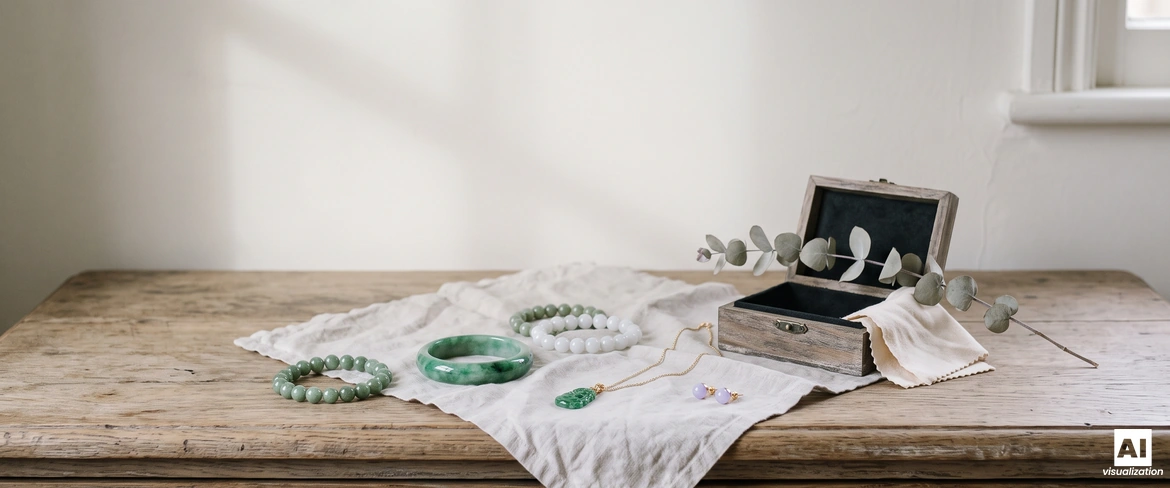
Durability, a pleasant coolness and a wealth of colours have made jadeite one of the jewellers’ favourite stones for centuries. It is found in bangles carved from a single piece of stone (traditional in Asia), in beaded bracelets, necklaces, earrings, rings and charms. Smooth cabochons and beads are popular, as are intricately carved pendants in the shape of leaves, flowers, dragons or good-luck symbols.
Particularly well loved are jadeite bracelets – light, comfortable and easy to combine with other accessories. Green beads look good on their own, white and lavender ones suit subtle styling, and red and yellow varieties add a colourful accent. For inspiration in creating your own set of stones, browse the category of jewellery with natural stones.
How to wear jadeite
Jadeite is a versatile stone – it suits both casual, everyday styling and elegant outfits. For daily wear, small charms, slim beaded bracelets and small earrings work well. For special occasions you can reach for more striking jewellery: a large carved pendant, a bangle made from a single piece of stone or a necklace of evenly matched, well-chosen beads.
- 💚 Green jadeite looks lovely in both gold and silver, as well as paired with white and beige.
- 🤍 White jadeite is a good choice for minimalist, light styling.
- 💜 Purple (lavender) jadeite combines easily with silver, pearls and rock crystal.
- 🧡 Red and yellow jadeite add warmth and go well with gold jewellery.
Jadeite can also be combined with other minerals, such as rock crystal, rose quartz or agate. It is worth storing them separately, however, so that harder stones do not scratch the jadeite. In the post How to wear protective stones so they really work? you will find tips on stones that are credited with protective symbolism.
How to care for jadeite?
Jadeite is tough, but proper care will keep its lustre and colour for many years. The safest way to clean it is warm (not hot) water with a little mild soap and a soft cloth. After washing, the stone should be dried thoroughly. It is worth rinsing massage accessories after each use to remove any traces of oil or serum.
- ✔️ avoid ultrasonic cleaners and steam – they are safe only for untreated stones, which is hard to tell without a certificate,
- ✔️ protect the stone from high temperatures and acids – they can damage resin-impregnated jadeite in particular,
- ✔️ put jewellery on after applying perfume and cosmetics, and take it off before cleaning with detergents,
- ✔️ store jadeite separately, in a soft pouch or a compartment of a jewellery box, so that harder stones do not scratch it,
- ✔️ take jewellery off before physical activity – even a tough stone can crack under a strong knock.
Many people also like to cleanse their stones symbolically, or energetically, for example with smoke, sound or moonlight. We have described various methods, matched to individual minerals, in the guide How to purify stones and crystals? A guide for everyone.
Jadeite is a stone where nature, history and symbolism meet. Its exceptional toughness allowed craftspeople of the past to create timeless sculptures and ornaments, and its wealth of colours means that everyone can find a shade of their own. Whether you are drawn to deep green, milky white or delicate lavender, it is worth getting to know this mineral better and appreciating its calm, refined beauty.
May jadeite – in every shade – be a reminder of harmony, calm and the beauty of nature!
FAQ – frequently asked questions about jadeite
1. What is jadeite?
Jadeite is a mineral from the pyroxene group, a sodium aluminium silicate, prized for thousands of years as an ornamental stone. Together with nephrite, it belongs to the stones known as “jade”. The most important deposits of jadeite are in Myanmar, with smaller ones in Guatemala, Japan and Russia, among other places.
2. What are the properties of jadeite?
Jadeite has a hardness of 6.5-7 on the Mohs scale, a density of approx. 3.3 g/cm³ and, thanks to its interlocked crystals, is very resistant to cracking. In esoteric tradition it is associated with harmony, calm, protection and prosperity – these are, however, symbolic meanings, not proven effects.
3. What colours does jadeite come in?
Green jadeite is the best known, but the mineral also occurs in white, purple (lavender), red, blue, yellow and black. Pure jadeite is white, and its colour comes from trace elements, mainly chromium, iron and manganese.
4. How to recognise genuine jadeite?
Reliable identification comes only from gemmological testing or a certificate. A glassy lustre, a fine-grained structure, a noticeable weight and uneven, natural colour can be clues, but home tests will not distinguish all imitations or resin-impregnated jadeite.
5. How does jadeite differ from nephrite?
They are two different minerals: jadeite is a pyroxene and nephrite an amphibole. Jadeite is slightly harder and heavier, occurs in more colours and has a glassy lustre when polished. Nephrite usually has a greasy or waxy lustre and is even more resistant to cracking.
6. Is jadeite used for massage?
Yes, gua sha plates, rollers and massage stones for the face and body are made from stones called jadeite. They are valued for their smooth, cool surface. Massage with such an accessory is treated above all as a pleasant skincare ritual and a moment of relaxation.
7. How to care for jadeite?
It is best cleaned with warm water, mild soap and a soft cloth, then dried thoroughly. Avoid ultrasonic cleaners, high temperatures, acids and detergents. Jewellery with jadeite is best stored separately so that harder stones do not scratch it.
8. Which zodiac signs suit jadeite?
In esoteric lists, jadeite is most often assigned to Taurus and Libra, less often to Aries. This is not a strict tradition, however, so anyone who feels drawn to its symbolism and look can choose jadeite.
9. Can jadeite be worn every day?
Yes. Thanks to its hardness and resistance to cracking, jadeite copes well with daily wear. It is worth taking jewellery off before cleaning, exercise and bathing, however, and protecting it from knocks and contact with cosmetics.
Recommended

Gua Sha Massage Stone – Jadeite
